
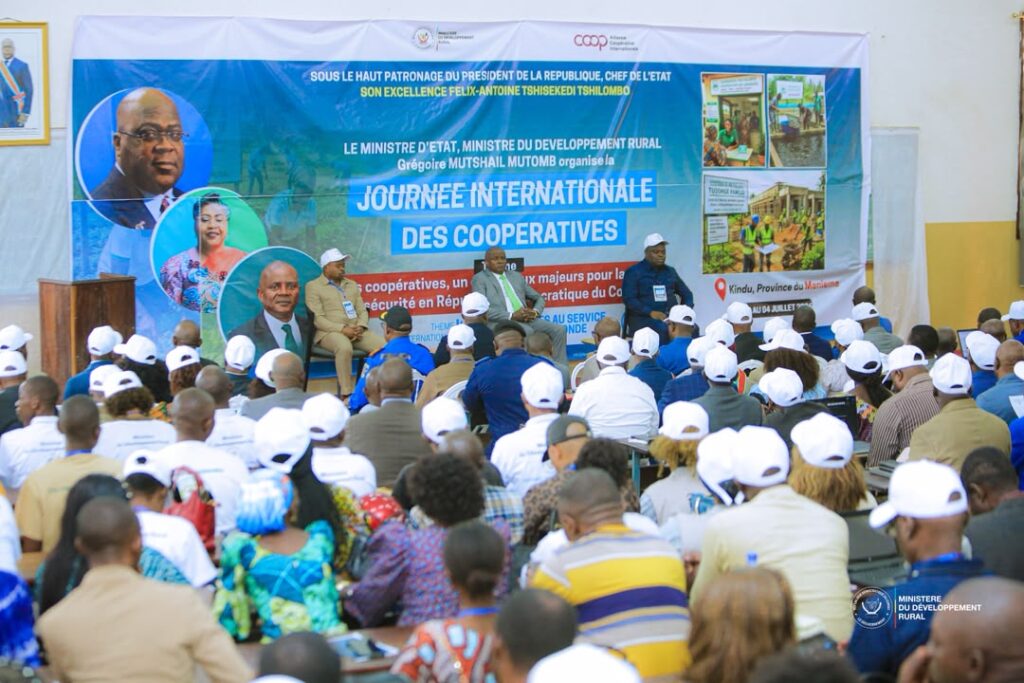
On July 4, 2026, the DRC celebrated the International Day of Cooperatives in the city of Kindu, Maniema province. This day was celebrated under the theme « Cooperatives, one of the major challenges for peace and security in the Democratic Republic of the Congo ». During this celebration, the Minister of Rural Development, Grégoire Mutshail Mutomb, revisited the three strategic pillars of his ministry. Since then, numerous reactions from sector stakeholders have poured in from all sides, criticizing the new direction linked to the creation of multisectoral cooperatives.

Reforms that fail to reassure
Thierry Munga, a stakeholder in the coffee-cocoa sector, tackles the central Government and the Ministry of Rural Development regarding the new reform of agricultural cooperatives in the DRC. Following the announcements made during the celebration of the International Day of Cooperatives in Kindu, Maniema province, Thierry Munga, a coffee-cocoa sector actor and Managing Director of the Amkeni Mkulima Agricultural Cooperative, expresses strong reservations about the new direction given to cooperatives in the Democratic Republic of the Congo.
The reform, notably marked by the promotion and free registration of multisectoral and multipurpose cooperatives, is presented by the Government as a lever for rural development and economic diversification. For Thierry Munga, however, this approach risks diverting agricultural cooperatives from their primary vocation.
« Every day we witness reforms that, instead of strengthening peasant organizations, make their functioning even more complicated. An agricultural cooperative was created to produce, process, and market agricultural products for the benefit of its members. It is this mission that needs to be consolidated, » advises Thierry Munga.
According to him, the shift toward multisectoral cooperatives creates confusion over the very identity of peasant organizations. « At this rate, farmers will have to be agricultural producers, mining operators, microfinance actors, artisans, and even intervene in other sectors all at once. This dispersion risks weakening cooperatives rather than strengthening them, » Thierry fears.
Overshadowed challenges of cooperatives
Thierry Munga considers that the difficulties faced by Congolese cooperatives are well known: weak management capacities, limited access to finance, insufficient processing infrastructure, difficult market access, lack of agricultural feeder roads, and lack of technical support. In his eyes, these challenges should constitute the true priorities of the reform.
Facing these difficulties, many sector actors also question the motivations underlying this new direction. They believe they seem to respond more to the requirements of certain technical and financial partners than to the realities experienced by Congolese producers.
« Before trying to transform agricultural cooperatives into multisectoral structures, we should first enable farmers to master the fundamentals of their trade: producing, processing, creating value, and sustainably supplying consumers, » he pleads.
While he acknowledges the authorities’ willingness to modernize the cooperative movement, Thierry Munga calls on the central Government and the Ministry of Rural Development to prioritize a reform based on specialization, the professionalization of agricultural value chains, and capacity building for existing cooperatives.
It should be noted that a successful cooperative is not one that multiplies its sectors of intervention, but one that effectively fulfills its economic mission in the service of its members and contributes sustainably to food security, income generation, and the development of rural territories.
En savoir plus sur Mkulima Média
Subscribe to get the latest posts sent to your email.